


Rabu, 27 April 2011
Best 16 Amazing Sand Sculptures
Sculptures can be made nearly out of everything. While I was searching for some images I saw a photo of a sand sculpture and was impressed, what people can do out of sand and also how big and detailed they can be, just awesome.


Best 10 Mysterious and Surreal Castle
There isn’t anything quite as mysterious and spectacular as an old castle. Many castles carry with them scars from histories most influential moments. In the Middle Ages rulers began building castles for protection. In a time of war, the castle was a stronghold for conquering nations. Castles have been battered and left inhabitable, but it is difficult to completely destroy a well built structure. In modern times many contemporary castles are being built, but they are mainly used for hotels and entertainment.
1. Het Steen Castle
2. Castle Stalker
Castle Stalker is a four-story tower house located near Port Appin, Argyll, by Scotland. It is believed that this structure was built around 1320 by Clan MacDougall, who was then Lords of Lorn. It was abandoned around 1840 when it lost its roof. In 1908, it was re-purchased and had basic conservation work done. This castle is quite famous and has appeared in the films Monty Python and the Holy Grail and two Highlander movies. It is one of the best examples of a medieval tower-house surviving in western Scotland.
3. Caernarfon Castle
Caernarfon Castle is located at Caernarfon in Gwynedd, north-west Wales. When Edward I took control of Gwynedd in 1283 by defeating Llywelyn ap Gruffudd, prince of Wales, he began building numerous castles and fortresses in the area. Some other notable structures built by Edward I were Conwy Castle, Harlech Castle, and later Beaumaris Castle. The fortress was constructed in a strategically important location. It is located on the banks of the River Seiont that flows into the Menai Strait.
4.The Albrechtsburg Meissen Castle
5. Eltz Castle (Burg Eltz)
Burg Eltz is a medieval castle nestled in the hills above the Moselle River between Koblenz and Trier, Germany. In the 13th century many towns were being founded in this area. Multiple owners came to claim this land and jointly built Burg Eltz. This was a common practice in some parts of the Roman Holy Empire of the German Nation, as only the very rich European lords could afford to build a castle solely on their land. This has caused the property to be divided into a community of joint heirs, which belong to different branches of certain families.
6. Moscow Kremlin
The Kremlin is one of the most lavish structures in the world. It is located in the heart of Moscow and overlooks the Moskva River to the south, Red Square to the east, and Alexander Garden to the west. It stands on the left bank of the Moscow River, where it connects to the Neglinnaya River. Kremlin is actually a Russian word for fortress or castle. This landmark consists of four palaces, four cathedrals, and the enormous Kremlin Wall. It is the residence of the President of Russia.
7. Krak des Chevaliers
This castle might be the most important preserved medieval military landmarks in the world. It is a crusader fortress located east of Tripoli, Lebanon, in Syria. It sits atop a 650-metre-high hill along the only route from Antioch to Beirut and the Mediterranean Sea. It is one of many fortresses that were built as a defensive network on the boarder of the old Crusader states. This base controlled the road to the Mediterranean Sea. During The Crusades this was an incredibly important structure. Around 1200 it was expanded to the largest crusader fortress in the Holy Land and was transformed into a concentric castle, which is a castle within another castle.
8. Edinburgh Castle
Edinburgh Castle is an ancient stronghold located atop Castle Rock in Edinburgh, the capital city of Scotland. It is unclear exactly when it was constructed, but there has been a royal castle at the location since the reign of David I in the 12th century. It continued to be a royal residence until 1603 and the Union of the Crowns. Edinburgh Castle has been involved in numerous historical conflicts, including the Wars of Scottish Independence in the 14th century and the Jacobite Rising of 1745. It has been besieged, both successfully and unsuccessfully on many occasions.
9. Burg Katz (Castle Rhine)
Burg Katz is a castle above the German town of St. Goarshausen. It is a truly remarkable structure tucked in the hillside. It was built around 1371 by Count Wilhelm II of Katzenelnbogen. It was originally used in the military as a commanding station. The castle also provided a transportation corridor through the German countryside. Burg Katz was an attractive target and was scarred by many battles. Spaniards conducted a siege in 1626 and the French tried to capture it in 1684 and again in 1692. In 1801, it was ultimately owned by France and Napoleon decided to blow it up in 1806. It remained in disrepair well into the late 19th century. The structure was rebuilt from 1896-98. Burg Katz houses a private Natural Science Grammar and Boarding School and is closed to the pubic. At least that is what they tell us, Hogwarts?
10. Caerlaverock Castle
Caerlaverock Castle was built in the 13th century in southwest Scotland. It is a unique structure and is a triangular double moated castle. Located very close to the border with England, this castle was vital in defending off English troops on numerous occasions. It was also besieged more then five times, most notably in 1300 by Edward I. After a siege in 1640 by Catholic Maxwells the castle was permanently abandoned. During this battle the south wall and tower were demolished, scars that remain today. Caerlaverock Castle is an extremely popoular tourist attraction and its ruins are in a National Nature Reserve in the care of Scottish Natural Heritage.
Kamis, 14 April 2011
Best Fly Geyser in Black Rock Desert
“They look as if they were taken on another planet, or at least on the set of a new and very expensive science fiction movie. Yet these pictures are of the Fly Geyser which is very much of planet earth (Nevada, US to be exact). However – and herein lies the surprise – it is effectively man made.
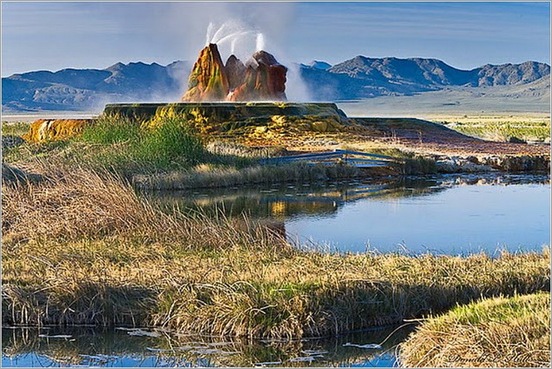
The geyser can be found in Hualapai Valley near Gerlach. It is a little seen phenomenon as the land upon which it sits is private. It can be seen from State Road 34 but unless you have permission the view from a distance is all you should attempt.

Back in 1916 the owners of the place were looking for water in the hope of creating rich farmland in this desert area of the state. They came across water, yes, and the well worked for decades. However, the drill that was driven down a shaft hit a geothermal pocket of water and the result was a geyser, if not quite made by man then certainly made possible by him.

Yet it is not the geyser you see in the pictures here. In the 1960s the water found another weak spot and a new, natural geyser was created. The older one no longer spouts at all. It is thought that the new geyser somehow diverted its water. Or perhaps it simply waits for another time to come when it can spring in to life again.”


Best 10 Greatest Empires in the History of World
An empire involves the extension of a state’s sovereignty over external territories. the greatness of an empire is based on the extent, population, economy, duration and many other factors such as type of rule and government, satisfaction by its people etc. The calculation of the land area of a particular empire is controversial. In general, the sequence in list centers on all the aspects that make an empire mighty, strong and progressive and all the factors as mentioned that make a kingdom great.
10. Akkadian Empire (2300 BC–2200 BC)

- It was the first empire to manifest on the earth.
- It reached record breaking size of its time and is considered the largest empire of dark ancient era – 0.8 million km2 (2250 BC)
9. Achaemenid Empire (550 BC–330 BC)

- It was the largest empire in ancient history. At the height of its power, the empire encompassed approximately 8 million km2
- In universal history the role of the Persian empire founded by Cyrus the Great lies in their very successful model for centralized administration and a government working to the advantage and profit of all.
8. Roman Empire (27 BC–AD 476/1453)

- The powers of an emperor existed, in theory at least, by virtue of his “tribunician powers” and his “proconsular powers” In theory, the tribunician powers made the emperor’s person and office sacrosanct, and gave the emperor authority over Rome’s civil government, including the power to preside over and to control the Senate. The proconsular powers gave him authority over the Roman army.
- Roman Empire achieved great territorial gains in both the East and the West. It had one of the strongest armies recorded.
- The enduring Roman influence is reflected pervasively in contemporary language, literature, legal codes, government, architecture, engineering, medicine, sports, arts, etc. Much of it is so deeply inbedded that we barely notice our debt to ancient Rome. Consider language, for example. Fewer and fewer people today claim to know Latin — and yet, go back to the first sentence in this paragraph. If we removed all the words drawn directly from Latin, that sentence would read; “The.”
7. Umayyad Caliphate (661–750)

- Ummayads had the best administration system the world had yet seen. To assist the Caliph in administration there were six Boards at the Centre: Diwan al-Kharaj (the Board of Revenue), Diwan al-Rasa’il (the Board of Correspondence), Diwan al-Khatam (the Board of Signet), Diwan al-Barid (the Board of Posts), Diwan al-Qudat (Board of Justice) and Diwan al-Jund (the Military Board).
- Fifth largest contiguous empire to ever exist.
- Modern Arab nationalism regards the period of the Umayyads as part of the Arab Golden Age.
6. Qing Dynasty (1890–1912)

- During its reign the Qing Dynasty became highly integrated with Chinese culture.
- The dynasty reached its height in the 18th century, during which both territory and population were increased.
- It covered an immense area of 14.7 million km2 (1790) making it the 5th largest according to land mass.
- It had the 4th largest %age of world’s GDP i.e 32.9% ($228.6 billion out of $694.4 billion in 1820)
5. Russian Empire (1721–1917)

- It was the second largest contiguous empire the world has ever seen, surpassed only by the Mongol Empire, and the third largest empire the world has ever seen, surpassed only by the British Empire and the Mongol Empire .
- The household servants or dependents attached to the personal service were merely set free, while the landed peasants received their houses and orchards, and allotments of arable land.
4. Mongol Empire (1206–1368)

- It is the largest contiguous empire in the history of the world, and the second largest empire in history, after the British Empire.
- Under the Mongols new technologies, various commodities and ideologies were disseminated and exchanged across Eurasia.
3. Mughal Empire (1526–1858)

- The Empire was marked by a highly centralized administration connecting the different regions.
- All the significant monuments of the Mughals, their most visible legacy, date to this period which was characterised by the expansion of Persian cultural influence in the Indian subcontinent, with brilliant literary, artistic and architectural results. A major Mughal contribution to the Indian Subcontinent was their unique architecture. Many monuments were built by the Muslim emperors, especially Shahjahan, during the Mughal era including the UNESCO World Heritage Site Taj Mahal, which is known to be one of the finer examples of Mughal architecture.
- The Indian economy remained as prosperous under the Mughals as it was, because of the creation of a road system and a uniform currency, together with the unification of the country. Manufactured goods and peasant-grown cash crops were sold throughout the world.
- n the Mughal Empire, the 16th and 17th centuries saw a synthesis of Muslim scientists who are the pioneers of modern science.
- It remained strong for longest duration above other empires and 4th largest population as compared to all other kingdoms – 175.0 million in 1700.
2. British Empire

- It was the largest empire by landmass covering 33.7 million km2 (1922)
- It was the largest empire by population.
- It had the second largest GDP size of $683.3 billion (in 1938) after the US in 1945
- It had the largest percent of world GDP 35.9% ($399 billion out of $1,111 billion in 1870)
- It had the largest military of all times.
- During the rule, people were quite unsatisfactory with the government and many disputes arose therefore the empire was soon brought done like house of cards as soon as it emerged, therefore although being largest, it is on second number.
1. Ottoman Empire (1299–1923)

- It existed at the globe for the longest period of time for 7 centuries.
- The Ottoman legal system accepted the religious law over its subjects. The Ottoman Empire was always organized around a system of local jurisprudence.
- The Ottoman Empire was, in principle, tolerant towards Christians and Jews.
- Numerous traditions and cultural traits of this previous empire (in fields such as architecture, cuisine, music, leisure and government) were adopted by the Ottomans, who elaborated them into new forms and blended them with the characteristics of the ethnic and religious groups living within the Ottoman territories, which resulted in a new and distinctively Ottoman cultural identity.
- By developing commercial centres and routes, encouraging people to extend the area of cultivated land in the country and international trade through its dominions, the state performed basic economic functions in the Empire.
- The empire was at the centre of interactions between the Eastern and Western worlds for seven centuries.
Via:Smashing Lists
Best 10 Most Bizarrely Shaped Lakes and Rivers
Nature tells you a story, of solace and existence. Similarities can be found in the things surrounding us but what is most astonishing is when water bodies cry for attention; through their various intriguing shapes and outlines, we look but we do not see.
1.The Lake Eros had a hand in

Nature again has romantic designs with a lake in the shape of the universal symbol for love. This one is to be found in the less frost-bitten environment of Kerala, India – specifically within the beautiful Wayanad district, near Chembra Peak, at about 1,398 metres above sea level. With a surface area of 1,827 square meters, it’s not a big a heart, but it is a fairly warm one.
2 The Lake that leads the Latin Alphabet

To be honest there are simply loads of heart-shaped lakes out there – everywhere from Ohio to Korea – so we just didn’t have room for all of them here. Shot from a balloon, this next lake – or perhaps more accurately pond – looks like the letter ‘A’ to us. Anyone know of other lakes that spell something out to them? We’d be interested to hear.
3. Schulensmeer Lake – Belgium
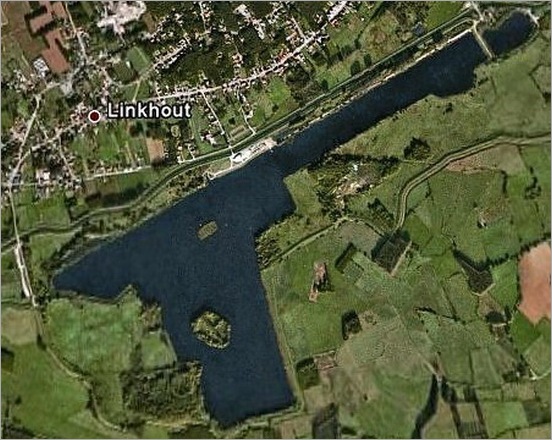
Nature had a little help from Man with this pistol-like body of water, Belgium’s 2.5 km long Schulensmeer, but it’s coincidence it looks like an ad for the next 007 movie. It was artificially created in the ’70s when sand was needed to build a nearby highway, and owes its shape to the parcels of land that were bought for this purpose. Popular for watersports, it’s also an overflow for the Demer River in case of flooding.
4. McKinley Lake – Alaska

This frozen-over, fish-shaped wonder was captured on Alaska’s Mt. McKinley, the highest mountain peak in North America at around 6,194 metres. Mount McKinley actually has a larger rise than Mount Everest, as its base sits at a much lower elevation of 610 m, and is also bulkier than its Himalayan rival. With such imposing facts, it’s no wonder this obscurely fishy lake is less well-known.
5. Sao Paulo Lake – Brazil

This next shape is clearly a product of deliberate human intervention in the natural landscape, a figure that stands some 140 metres tall in a lake located near Iacanga in the Brazilian state of São Paulo. However, aside from its location and vital statistics, information about this strange piece of land art is scarce. Anyone know anything we don’t? If so, pray do tell.
6.The Lake that says ‘How do you do?’
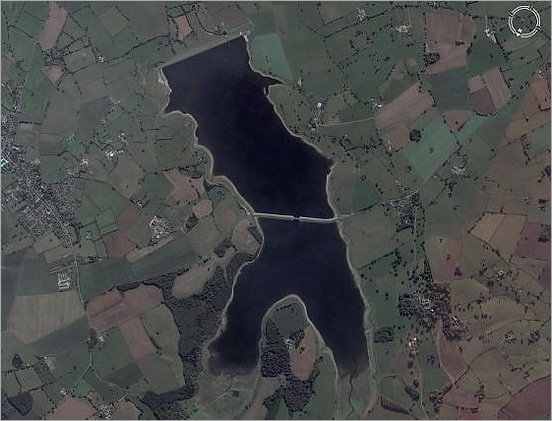
The previous lake may have been man-shaped by design, but this next one looks more natural; natural but not au naturel – see he’s wearing a hat and cane as he walks across the countryside. We’re not sure where this is, but we’ve featured it on EG before and one commenter reckoned it could be Blythefield Reservoir in Staffordshire, England; another said it must be Mr. Peanut of Planters fame.
7. Horseshoe Lake – Canada

Canada’s aptly-named Horseshoe Lake might bring luck for some, but geographically oxbow lakes like this are not uncommon. These sweeping U-shaped bodies of water are formed when a wide meander from a river’s main stem is cut off, creating the characteristically curved lake. This fine-looking example is located along the long the Red River, near Morris in southern Manitoba.
8. Fisheating Creek – Florida
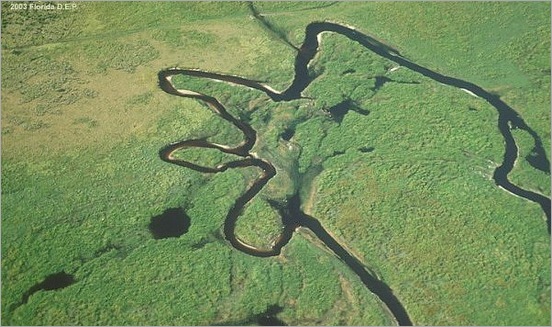
In this next pic a few emergent oxbow lakes are visible, one of which forms the eye of some strange-looking creature. Is it a bird sticking out its tongue and spitting stuff out? Maybe it’s just us. Anyways, the zigzagging body of water forming the outline of whatever-it-is is Fisheating Creek, which runs through Cowbone March west of Florida’s Lake Okeechobee, itself known as The Big O.
9.Horseshoe Bend – Arizona
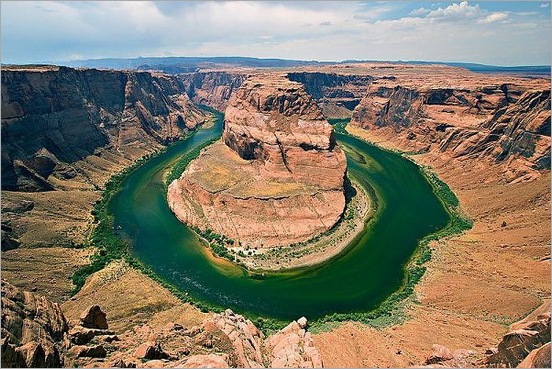
So how do oxbow lakes arise? Well many of them start out a lot like this. Yes, we know, it isn’t a lake, but it could be one in the making. This is Arizona’s Horseshoe Bend, a magnificent meander of the Colorado River situated slightly downstream from Lake Powell within Glen Canyon National Recreation Area. From the steep cliff above, some 305 metres higher up, it makes a breathtaking sight.
10.Heart shaped lake, possibly in Korea

Look hard enough and you’ll see the physical environment, both natural and man-made, has a message for us – sometimes in the most unusual places. Lakes and other bodies of water aren’t the first places one might expect to discern symbols, figures and other shapes, but viewed from above they can be surprisingly communicative. We’ve scoured the globe for images of lakes whose shapes speak volumes.
Langganan:
Postingan (Atom)