Tampilkan postingan dengan label best 10. Tampilkan semua postingan

Sabtu, 30 April 2011

Best 10 Coolest Google Earth Finds

This heart-shaped island in the Adriatic became a hit on Google Earth for Valentine's Day. The uninhabited island is only 130,000 square yards and is called Galesnjak. The owner didn't even know how perfectly this island off the Croatian coast was until he was swamped with requests from couples to stay there.

Cool Places on Google Earth

Dubbed the "Badlands Guardian" by locals, this geological marvel (Google Earth coordinates 50.010083,-110.113006) in Alberta, Canada, bears an uncanny resemblance to a human head wearing a full Native American headdress--and earphones, to boot. Of course, The Guardian was produced naturally.

Cool Places on Google Earth

A synthetic wonder that can be truly appreciated only from above, this giant man-shaped lake (-21.805149,-49.089977) is located near Bauru, Brazil.

Cool Places on Google Earth

This fingerprint can be found in Hove Park, near Brighton and Hove in the UK. It measures 38 metres around. Imagine the size of the hand.

Cool Places on Google Earth

Lion, at ZSL Whipsnade Zoo located at Whipsnade, near Dunstable in Bedfordshire, England.

Cool Places on Google Earth

Some of the sights you find in Google Earth are just plain mysterious. For example, why is a fighter jet parked (Google Earth coordinates 48.825183,2.1985795) in what looks to be a residential neighborhood lot near Paris?

Cool Places on Google Earth

This is a US Navy building in Coronado, Ca. that was unintentionally built in the shape of a swastika. Now, because of a public uproar, the Navy will be spending $600,000 to alter the shape of the building.

Cool Places on Google Earth

In the early days of Firefox, a few devoted fans wanted to generate more PR for their beloved site and so gathered a team of people in Amity, Oregon, to recreate the Firefox logo in a field; their very own fox crop.

Cool Places on Google Earth

Last year, one of the Google Earth Community members called 'ear1grey' posted an amazing discovery. He found a huge picture (36 miles tall) of Santa!

Cool Places on Google Earth

So here's a giant Ipod Shuffle! It looks like a farmer's field with a horse pen or something on it? Either that or a hard core apple enthusiast. Unfortunately, it looks like he moved the pen on the map since it was first spotted.

Cool Places on Google Earth

Google Earth doesn't have advertising, unless you consider the corporate logos and trademarks big enough to be seen from space. Check out this massive Coca-Cola logo (-18.529225,-70.25002) etched into a hillside of Chile with 70,000 Coke bottles. Haven't they heard of recycling?

Rabu, 27 April 2011

Best 10 Architectural Wonders of the World

We know about natural wonders of the world like the Grand Canyon, Mount Everest, Niagara Falls and so on...But why not we think about the Man - Made Wonders. Lets talk about the absolute must-see buildings. The ones that will make your jaw drop and will have you asking, "how did they do that!?"

Here is a list of "Top 10 Architectural Wonders Of The World"

10. Empire State Building, New York City, NY

Empire State  Building

This art deco skyscraper stood as the world's tallest building for more than forty years and now it's 12th. The empire state building is one of the world’s most recognizable skyscrapers. Empire state building is one of the popular attraction in New York city. The tower has 102 storeys and was built in the 30s. There are two observatories, one is on the 86th floor, where you can see a breath-taking 360-degree view of the city. There is also a much smaller observation deck on the 102nd floor.

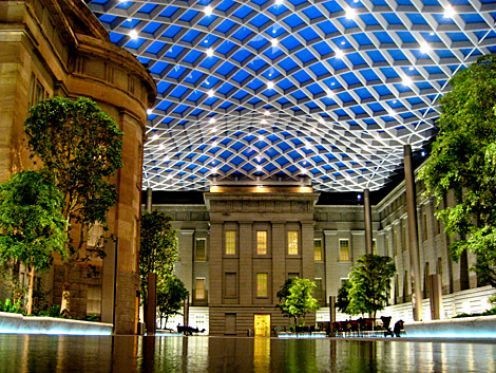
9. Kogod Courtyard, Washington D.C.

Kogod Courtyard, Washington

The courtyard was designed to make visitors feel like they’re outside, without having to deal with cold and rain. Thus, a roof was necessary to making the space truly useful, and the architects decided upon a wavy glass and steel structure, with glass panels set in a grid and supported by columns. There are several pools of water, which are only a quarter inch deep. They reflect the courtyard and can also be turned off to accommodate more people in the space. Adorning the courtyard are two 32-foot ficus trees and 16 black olive trees, which are filled in with a variety of shrubs and ferns. The space is 28,000 square feet, and will feature free wireless internet access. it was Designed by Norman Foster, this elegant glass canopy was built as an addition to the museum and houses part of the Smithsonian's art gallery. It won the prestigious Pritzker Architecture Prize in 1999. It's over 28,000 square feet of glass and gives the impression of a floating ceiling.

8. Panama Canal, Panama

Panama Canal

Panama canal is a man-made canal was. It remains as one of the most difficult and impressive engineering feats of our time. Panama Canal links the Pacific and Atlantic oceans. Tt was built as a travel port and has had an enormous impact on shipping between the east and west. Each year over 14,000 vessels pass through its concrete tunneled walls. The canal has been enormously successful, and continues to be a key conduit for international maritime trade. The canal can accommodate vessels from small private yachts up to large commercial vessels.

7. Red Ribbon, Qinhuangdao, China

Red Ribbon, Qinhuangdao

In Qinhuangdao, China the Tanghe River Park features a new installation of a red steel bench that runs for half a kilometre through the park. The Red Ribbon project is th winner of American Society of Landscape Architects award and was also selected by readers of Conde Nast Traveller magazine as one of the seven new wonders of the architecture world. This knee-high red steel bench acts as a viewing place for the area's lush vegetation and diverse species. The challenge of this project is to protect the good ecological condition of the site and to ensure safety hygiene accessiblity and attractiveness, allowing people touse the site as an urban park. This "red ribbon" provides seating, environmental interpretation, lighting and displaying of native plants.

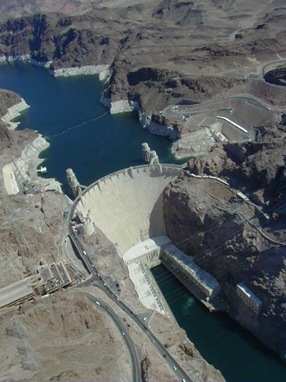
6. Hoover Dam, Border of Arizona and Nevada

Hoover Dam

Hoover Dam, originally known as Boulder Dam, is a concrete arch-gravity dam in the Black Canyon of the Colorado River, on the border between the U.S. states of Arizona and Nevada. Hoover Dam is one of the world's largest hydro-electric generating stations. Hoover Dam is one of the most jaw-dropping sites in the US. The dam is named after America's 31st president, Herbert Hoover, who played a large role in bringing the nearby states into agreement about water allocations, settling a 25-year controversy. One more great thing about this dam is it was completed ahead of schedule. Construction began in 1931 and finished in 1936. Two years ahead of schedule and well under budget.

5. The Channel Tunnel aka The Chunnel, Europe

The Channel Tunnel

The Channel Tunnel, also known as the Chunnel,is a 50.5-kilometre undersea rail tunnel linking Folkestone, Kent in England with Coquelles, near Calais in northern France beneath the English Channel at the Strait of Dover. The Channel actually consists of three tunnels bored in the rock below the seabed of the Channel. Two of the tubes are full sized and accommodate rail traffic. In between the two train tunnels is a smaller service tunnel that serves as an emergency escape route. There are also several cross-over passages that allow trains to switch from one track to another.Today, trains roar through the tunnel at speeds up to 100 miles per hour and it's possible to get from one end to the other in only 20 minutes!

4. CN Tower, Toronto, Ontario, Canada

CN Tower, Toronto

The CN Tower is the world's tallest building as well as Canada's most recognizable icon. The tower is the centre of tourism in Toronto. From the top of the tower you can view the breathtaking view of downtown Toronto. Things to do in the tower include walking on glass floor, eating over 1000 ft above ground at the revolving 360 Restaurant, watching a movie about the construction of the CN tower and of course enjoying the view. It is also a centre for telecommunications in Toronto.

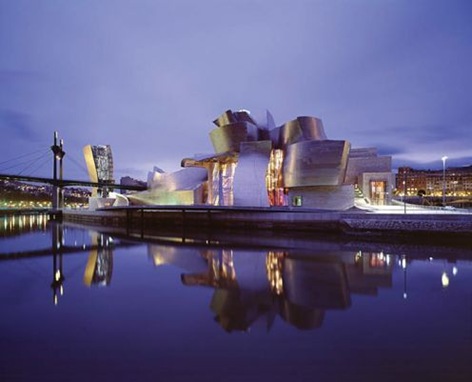
3.The Guggenheim Museum Bilbao, Basque Country, Spain

Guggenheim Museum Bilbao

The Guggenheim Museum Bilbao is a museum of modern and contemporary art. It was designed by Canadian-American architect Frank Gehry and built by Ferrovial. The museum is located in Bilbao, Basque Country, Spain. It is built alongside the Nervion River, which runs through the city of Bilbao to the Atlantic Coast. The exhibitions in the museum itself change often, the museum hosts thematic exhibitions, centered for example on Chinese or Russian art. The museum features permanent and visiting exhibits of works by Spanish and international artists. The circular body is signature to the architect and was built to showcase the museum's pieces in a unique way. It stands alongside Spain's magnificent Nervion River.

2. Golden Gate Bridge, San Francisco, CA

Golden Gate Bridge

Arching over the Pacific ocean, the Golden Gate Bridge links San Francisco to Marin County . The Golden Gate Bridge is acclaimed as one of the world's most beautiful bridges and with its tremendous towers, sweeping main cables and great span, it is a sensory beauty featuring color, sound, and light. The Bridge can be a very busy place, particularly during the summer months. Pedestrians can walk the bridge to get sprawling views of San Francisco's harbor. Historically, it's also one of the most photographed bridges in the world.

1. Burj Dubai, United Arab Emirates

Burj Dubai, United Arab  Emirates

Burj Dubai is a supertall skyscraper under construction in Dubai, United Arab Emirates. It is the tallest man-made structure ever built. Construction began on 21 September 2004, and the tower is expected to be completed and ready for occupancy by September 2009. This structure will be the world's tallest building once it's completed. Although the height has been a well-kept secret, experts predict it will be over 2200 feet and tower plans suggest an outdoor swimming pool will be located on the 78th floor and the 124th floor will be an observation deck. It will also, reportedly, contain the world's fastest elevator.

Best 10 Most Dangerous Airports To Land

Engineers tasked with building an airport are faced with countless challenges: The ideal location needs ample space, endless flat ground, favorable winds and great visibility. But spots in the real world are rarely ideal, and engineers are forced to work with what they have, making sure that the end product is the safest possible structure for pilots. A survey of airports around the world turns up a mixed bag, ranging from dangerous and rugged landing strips to mega-size facilities that operate like small cities. Here, PM explores the world's most remarkable airports and why they stand out.

1. Kansai International Airport

Osaka, Japan

Kansai International Airport

Land is a scarce resource in Japan, so engineers headed roughly 3 miles offshore into Osaka Bay to build this colossal structure. Work on the manmade island started in 1987, and by 1994 jumbo jets were touching down. Travelers can get from the airport to the main island of Honshu via car, railroad or even a high-speed ferry.

Kansai's artificial island is 2.5 miles long and 1.6 miles wide—so large that it's visible from space. Earthquakes, dangerous cyclones, an unstable seabed, and sabotage attempts from protestors are just some of the variables engineers were forced to account for. As impressive as the airport is, Stewart Schreckengast, a professor of aviation technology at Purdue University and a former aviation consultant with MITRE, cautions that climate change and rising sea levels pose a very real threat to the airport's existence. "When this was built, [engineers] probably didn't account for global warming," he says. "In 50 years or so, this might be underwater."

2. Gibraltar Airport

Gibraltar

Gibraltar Airport

Between Morocco and Spain sits the tiny British territory of Gibraltar. Construction of the airport dates back to World War II, and it continues to serve as a base for the United Kingdom's Royal Air Force, though commercial flights land on a daily basis.

Winston Churchill Avenue, Gibraltar's busiest road, cuts directly across the runway. Railroad-style crossing gates hold cars back every time a plane lands or departs. "There's essentially a mountain on one side of the island and a town on the other," Schreckengast says. "The runway goes from side to side on the island because it's the only flat space there, so it's the best they can do. It's a fairly safe operation as far as keeping people away," he says, "It just happens to be the best place to land, so sometimes it's a road and sometimes it's a runway."

3. Madeira International Airport

Madeira, Portugal

Madeira International  Airport

Madeira is a small island far off the coast of Portugal, which makes an airport that is capable of landing commercial-size aircraft vital to its development. This airport's original runway was only about 5000 feet long, posing a huge risk to even the most experienced pilots and limiting imports and tourism.

Engineers extended the runway to more than 9000 feet by building a massive girder bridge atop about 200 pillars. The bridge, which itself is over 3000 feet long and 590 feet wide, is strong enough to handle the weight of 747s and similar jets. In 2004, the International Association for Bridge and Structural Engineering selected the expansion project for its Outstanding Structure Award, noting that the design and construction was both "sensitive to environmental and aesthetic considerations."

4. Don Mueang International Airport

Bangkok, Thailand

Don Mueang  International Airport

From a distance Don Mueang International looks like any other midsize airport. However, smack-dab in the middle of the two runways is an 18-hole golf course.

Schreckengast, who has worked on consulting projects at this airport, says one of the major problems is that the only taxiways were located at the end of the runways. "We recommended that they build an additional taxiway in the middle, from side to side, and they said ‘absolutely not, that will take out a green and one fairway.'" The airport and the course were originally an all-military operation, but have since opened up to commercial traffic. Security threats, however, have limited the public's access to the greens.

5. Ice Runway

Antarctica
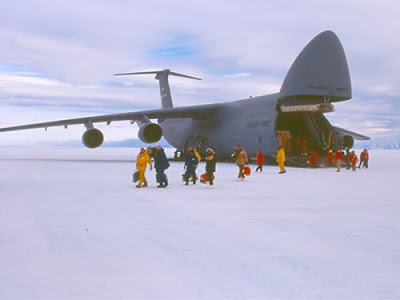
Ice Runway

The Ice Runway is one of three major airstrips used to haul supplies and researchers to Antarctica's McMurdo Station. As its name implies, there are no paved runways here—just long stretches of ice and snow that are meticulously groomed.

There is no shortage of space on the Ice Runway, so super-size aircraft like the C-130 Hercules and the C-17 Globemaster III can land with relative ease. The real challenge is making sure that the weight of the aircraft and cargo doesn't bust the ice or get the plane stuck in soft snow. As the ice of the runway begins to break up, planes are redirected to Pegasus Field or Williams Field, the two other airstrips servicing the continent.

6. Congonhas Airport

Sao Paulo, Brazil

Congonhas Airport

Most major cities have an airport, but rarely are they built just 5 miles from the city center, especially in metropolises like Sao Paulo. Congonhas' close proximity to downtown can be attributed in part to the fact that it was completed in 1936, with the city experiencing rapid development in the following decades.

While having an airport only 5 miles from the city center may be a convenience for commuters, it places a strain on both pilots and air traffic control crews. "It becomes a challenge in terms of safety to just get the plane in there," Schreckengast says. "Then you throw on noise restrictions and these terribly awkward arrival and departure routes that are needed to minimize your noise-print and it becomes quite challenging for pilots." Fortunately, Sao Paulo's many high-rise buildings are far enough away from the airport that they aren't an immediate obstacle for pilots landing or taking off.

7. Courchevel International Airport

Courchevel, France
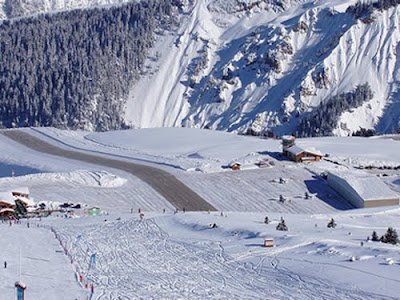
Courchevel International Airport

Getting to the iconic ski resort of Courchevel requires navigating the formidable French Alps before making a hair-raising landing at Courchevel International Airport. The runway is about 1700 feet long, but the real surprise is the large hill toward the middle of the strip.

"You take off downhill and you land going uphill," Schreckengast says. He adds that the hill, which has an 18.5 percent grade, is so steep that small planes could probably gain enough momentum rolling down it with no engines to safely glide off the edge. Landing at Courchevel is obviously no easy task, so pilots are required to obtain certification before attempting to conquer the dangerous runway.

8. Princess Juliana International Airport

Simpson Bay, Saint Maarten

Princess Juliana International Airport

Nothing says fun in the sun like roaring engines and the smell of jet exhaust. Landing on this Caribbean island forces pilots to fly over a small strip of beach, clear a decent-size fence and pass over a road just before hitting the runway.

Not many airports are flanked by oceanfront property filled with tourists standing under incoming aircraft. While the tourists are not really in harm's way—with the exception of their hearing—Schreckengast says that trucks driving on the small road between the beach and the runway could be at risk. "The challenge is to make sure there's not a big semi truck coming through when the plane is landing. It becomes a vertical obstacle, and, if the truck is light, the jet blast could blow it over.

9. Svalbard Airport

Svalbard, Norway
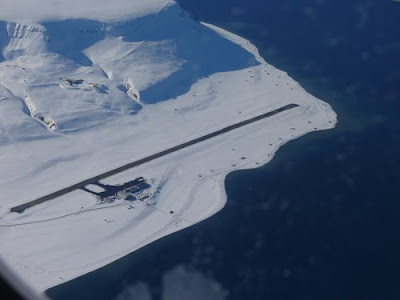
Svalbard Airport

Svalbard is a cluster of Norwegian islands sitting in the Arctic Ocean. While there are three airports within the archipelago, two of which are used mainly to transport miners, Svalbard Airport is open to commercial travel, making it the world's northernmost airport that tourists can book tickets to.

Engineers used the region's brutally cold climate to their favor during construction and built the runway on a layer of permafrost. The airport was completed in 1975, but slight seasonal changes caused sections of the runway to become uneven, forcing the need to repave the runway on several occasions. A project was launched in 1989 aimed at insulating troublesome sections of the runway from the ground, which proved relatively successful. However, a 2002 study indicates that rising temperatures in the area may increase the need and frequency of maintenance efforts and repaving.

10. Juancho E. Yrausquin Airport

Saba, Netherlands Antilles

Juancho E. Yrausquin Airport

Getting to this paradise-like island can be a bit distressing thanks to a 1300-foot-long runway, slightly longer than most aircraft carrier runways.

Large planes aren't landing here, but the small runway is difficult even for Cessnas and similar aircraft. "The little X means don't land there," says Schreckengast, a former Navy pilot who is no stranger to landing on less than lengthy runways. "It's challenging, but if you don't have something like that, the people here don't get things they routinely need, like mail." Given the limited amount of land and rolling topography of the island, not many other options exist.

Best 10 Deadliest Volcanic Eruptions

Volcanic eruptions are deemed the most dangerous forms of natural catastrophe. The flow of burning red lava hardly gives enough time to flee. That accounts for the massive casualty lists you will find in countries and regions threatened with an active volcano. Apart from the immediate loss of life and weather anomaly, such eruptions lead to far-reaching changes in climatic conditions, often taking several years for bringing things back to normal.

10. Mount Vesuvius, Italy (3,360 deaths in August 24 AD 79)

vesuvius_from_plane

Mount Vesuvius stands tall on the coast of Bay of Naples and graces the beautiful landscape of Naples that lays ahead to its remarkable elevation. Notwithstanding its scenic beauty, Mount Vesuvius has given way to a number of eruptions, among which the one occurring in AD 79 was violent enough to destroy the prosperous Roman cities of Herculaneum and Pompeii.

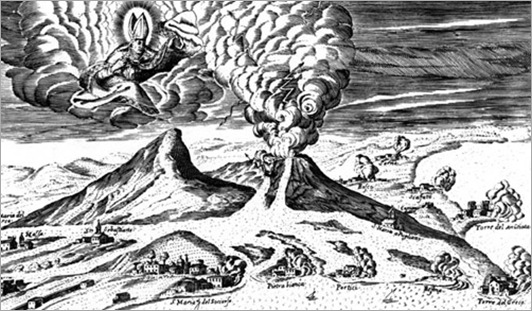
9. Mount Vesuvius, Italy (3,500 deaths in December 1631)

e1631beforeafter

Mount Vesuvius on the Bay of Naples, Italy holds the record for being the only active volcano in Europe that has erupted in the last hundred years. Right from the Roman era, Vesuvius has kept erupting time and again with varying intensity. The eruption of 1631 was of a particularly destructive nature that took its toll on almost 3,500 residents and their village settlements. Apart from the molten lava, streams of boiling hot water was also ejected that served to aggravate the devastations.

8. Galunggung, Indonesia (4,011 deaths in 1882)

galunggung

This is yet another of the deadly active stratovolcanoes of Indonesia, belonging to the Pacific Ring of Fire that erupted in West Java of Indonesia in 1882. The Ten Thousand Hills of Tasik Malaja on the southeast slope of Galunggung Volcano has long remained a subject of speculation for Western geologists who have propounded different theories for their formation. While some suggest that, the accumulating deposits of liquid lava leakage formed them, others propose they have been created artificially.

7. Kelut, Indonesia (5,110 deaths in 1919)

Kelut, Indonesia

This volcano located in East Java and Indonesia is notorious for almost 30 explosive eruptions that have the marked its history since 1000 A.D. The eruptions occurring in the years 1951, 1966, and 1990 were collectively responsible for the death of 250 people. The 1919 eruption was of a magnitude that has surpassed all recent records of destruction mainly due to its massive mudflow that took 5,110 lives.

6. Laki, Iceland (9,350 deaths in 1783)

Laki, Iceland Laki is the other name for the term Lakagígar meaning ‘Craters of Laki’ – a system of Eldgjá canyon and Katla volcano found between the Mýrdalsjökull and Vatnajökull glaciers near the Kirkjubæjarklaustur town. After the large eruption of AD 934, history repeated itself on 8 June 1783 when about 14 km3 of thick basalt lava emitting from the Grímsvötn volcano and Laki fissure flooded the plains.

5. Mount Unzen, Japan (14,300 deaths in 1792)Mount Unzen

Mount Unzen stands out as an active volcano from among a group of interlacing stratovolcanoes bracing the city of Shimabara in the Kyūshū Island. The volcano has again become active in the last decade and pyroclastic flows were reported latest in 1991. However, these are nothing compared to the 1792 post-eruption earthquake and the subsequent collapse of many volcanic domes including the eastern part of the Mayuyama dome that set in motion killer tsunamis. This was coupled by the deadly dacitic lava flow from the nearby Fugen-dake peak. Recent tests are being carried out by volcanologists to find out the possibility of the repetition of such tragedy.

4. Mount Ruiz, Colombia (25,000 deaths in October 1985)

Mount Ruiz

The Andean stratovolcano Nevado Del Ruiz or Mount Ruiz is located in Colombia’s Caldas Department that falls within the ‘Pacific Ring of Fire’. Although this volcanic cone had been active since the early Pleistocene epoch, its 1985 eruption and the subsequent mudflow were phenomenal and sufficient to wipe out the very existence of Armero. The October 1985 disaster that measured 3 in the Volcanic Explosive Index came as a shock since Mt. Ruiz had been inactive for 150 years.

3. Mount Pelee, Martinique (30,000 deaths in April-May 1902)

Mount Pelee

Situated in the northern fringe of Martinique, Mt. Pelee is one of the greatest stratovolcano of the world that created havoc in the city of Saint-Pierre with its massive 1902 eruption. Saint-Pierre use to be a fairly large and prosperous city of the French Caribbean until the unlucky day of 25 April when a series of explosive eruptions heralded the oncoming catastrophe. Within no time, the streets of Saint-Pierre were covered in layers of volcanic ash.

2. Krakatoa Volcanic Island, Indonesia (36,417 deaths in August 1883)

Krakatoa Volcanic Island This notorious volcanic island is situated between Sumatra and Java. The devastations caused by the serial eruptions on August 26 and 27 of 1883 have even outshone the Hiroshima nuclear bombings in impact and sound. It was heard from as far as Australia and Mauritius! The eruption that ranged up to 6 in the Volcanic Explosive Index wiped out two-thirds of the Krakatoa Island. It was followed by all-engulfing tsunamis that ravished the city of Merak and disrupted vessels floating on the South African coast.
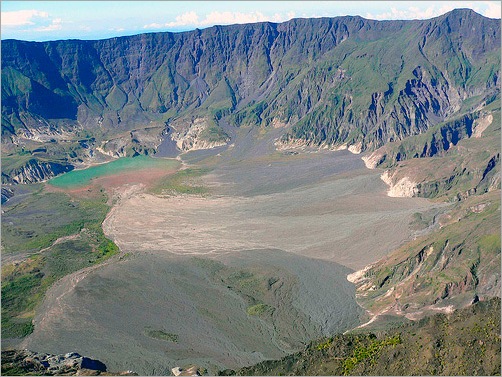
1. Mount Tambora, Indonesia (92,000 deaths in the April 1815 eruption)

Mount Tambora This 4,300 m high active stratovolcano located in Sumbawa Island of Indonesia drained the contents of its massive magma chamber in April 1815 accumulated over centuries. The impact of this titanic explosion measured 7 in the Volcanic Explosive Index and was felt throughout 1816 with gross climatic changes, a mini tsunami, volcanic ash rain and destruction of crops and livestock that caused a lasting famine in Northern Hemisphere.

Best 10 Mysterious and Surreal Castle

There isn’t anything quite as mysterious and spectacular as an old castle. Many castles carry with them scars from histories most influential moments. In the Middle Ages rulers began building castles for protection. In a time of war, the castle was a stronghold for conquering nations. Castles have been battered and left inhabitable, but it is difficult to completely destroy a well built structure. In modern times many contemporary castles are being built, but they are mainly used for hotels and entertainment.

1. Het Steen CastleHet Steen  Castle Het Steen (The Stone) is an ancient medieval castle built in the old city center of Antwerp, Belgium, which is one of Europe’s biggest ports. Built around 1225 it is Antwerp’s oldest building. The castle was constructed in part to control access to the Schelde, the river that flows through this area. It was also used as a prison between 1303 and 1827. There are often reports of weird noises and ghostly activity on the grounds of Het Steen. The castle is being used for various museum exhibits.

2. Castle StalkerCastle Stalker

Castle Stalker is a four-story tower house located near Port Appin, Argyll, by Scotland. It is believed that this structure was built around 1320 by Clan MacDougall, who was then Lords of Lorn. It was abandoned around 1840 when it lost its roof. In 1908, it was re-purchased and had basic conservation work done. This castle is quite famous and has appeared in the films Monty Python and the Holy Grail and two Highlander movies. It is one of the best examples of a medieval tower-house surviving in western Scotland.

3. Caernarfon CastleCaernarfon  Castle

Caernarfon Castle is located at Caernarfon in Gwynedd, north-west Wales. When Edward I took control of Gwynedd in 1283 by defeating Llywelyn ap Gruffudd, prince of Wales, he began building numerous castles and fortresses in the area. Some other notable structures built by Edward I were Conwy Castle, Harlech Castle, and later Beaumaris Castle. The fortress was constructed in a strategically important location. It is located on the banks of the River Seiont that flows into the Menai Strait.

4.The Albrechtsburg Meissen CastleAlbrechtsburg Meissen Castle This structures history spans all the way back to 929 when a military camp was established between the rivers Meisa, Triebisch, and Elbe. The castle was destroyed in the 15th century and redesigned by Arnold of Westphalia, mostly in the late Gothic style. This landmark dominates the city centre of Meissen, Germany. In 1645, Swedish General von Königsmark captured the castle during the Thirty Years War. The structure was a factory for the first fine European china, Meissen porcelain, from 1700-1850. During World War II Albrechtsburg was used as storage for artistic inventories of the Dresden Art Collections and some other stolen artifacts

5. Eltz Castle (Burg Eltz)Eltz Castle

Burg Eltz is a medieval castle nestled in the hills above the Moselle River between Koblenz and Trier, Germany. In the 13th century many towns were being founded in this area. Multiple owners came to claim this land and jointly built Burg Eltz. This was a common practice in some parts of the Roman Holy Empire of the German Nation, as only the very rich European lords could afford to build a castle solely on their land. This has caused the property to be divided into a community of joint heirs, which belong to different branches of certain families.


6. Moscow KremlinMoscow Kremlin

The Kremlin is one of the most lavish structures in the world. It is located in the heart of Moscow and overlooks the Moskva River to the south, Red Square to the east, and Alexander Garden to the west. It stands on the left bank of the Moscow River, where it connects to the Neglinnaya River. Kremlin is actually a Russian word for fortress or castle. This landmark consists of four palaces, four cathedrals, and the enormous Kremlin Wall. It is the residence of the President of Russia.


7. Krak des ChevaliersKrak des  Chevaliers

This castle might be the most important preserved medieval military landmarks in the world. It is a crusader fortress located east of Tripoli, Lebanon, in Syria. It sits atop a 650-metre-high hill along the only route from Antioch to Beirut and the Mediterranean Sea. It is one of many fortresses that were built as a defensive network on the boarder of the old Crusader states. This base controlled the road to the Mediterranean Sea. During The Crusades this was an incredibly important structure. Around 1200 it was expanded to the largest crusader fortress in the Holy Land and was transformed into a concentric castle, which is a castle within another castle.

8. Edinburgh CastleEdinburgh  Castle

Edinburgh Castle is an ancient stronghold located atop Castle Rock in Edinburgh, the capital city of Scotland. It is unclear exactly when it was constructed, but there has been a royal castle at the location since the reign of David I in the 12th century. It continued to be a royal residence until 1603 and the Union of the Crowns. Edinburgh Castle has been involved in numerous historical conflicts, including the Wars of Scottish Independence in the 14th century and the Jacobite Rising of 1745. It has been besieged, both successfully and unsuccessfully on many occasions.

9. Burg Katz (Castle Rhine)Burg Katz

Burg Katz is a castle above the German town of St. Goarshausen. It is a truly remarkable structure tucked in the hillside. It was built around 1371 by Count Wilhelm II of Katzenelnbogen. It was originally used in the military as a commanding station. The castle also provided a transportation corridor through the German countryside. Burg Katz was an attractive target and was scarred by many battles. Spaniards conducted a siege in 1626 and the French tried to capture it in 1684 and again in 1692. In 1801, it was ultimately owned by France and Napoleon decided to blow it up in 1806. It remained in disrepair well into the late 19th century. The structure was rebuilt from 1896-98. Burg Katz houses a private Natural Science Grammar and Boarding School and is closed to the pubic. At least that is what they tell us, Hogwarts?

10. Caerlaverock CastleCaerlaverock  Castle

Caerlaverock Castle was built in the 13th century in southwest Scotland. It is a unique structure and is a triangular double moated castle. Located very close to the border with England, this castle was vital in defending off English troops on numerous occasions. It was also besieged more then five times, most notably in 1300 by Edward I. After a siege in 1640 by Catholic Maxwells the castle was permanently abandoned. During this battle the south wall and tower were demolished, scars that remain today. Caerlaverock Castle is an extremely popoular tourist attraction and its ruins are in a National Nature Reserve in the care of Scottish Natural Heritage.